The decision is not about finding a universal feature list. It is about deciding what must work reliably around the screen estate.
The right CMS depends on the operating context: whether a team needs a vertically designed QSR workflow, a broad display-management platform, a mixed-device deployment, a particular hardware ecosystem, or a defined approach to third-party business data.
This is a practical starting point, not a feature-parity scorecard. Provider services, plans, compatible devices, integrations and commercial terms can change. Procurement teams should validate the exact solution scope with the relevant provider before committing to an implementation.
Start with the operating model
Assess the workflows around the screens.
Dhruv is designed around two purpose-built verticals: Dhruv QSR for menu, pricing, campaign, availability, screen-context and priority-message operations; and Dhruv Workplace for workplace, estate and controlled-communications workflows. Its public capability set includes a confirmed Flipdish live-price reference, screen-aware publishing, configured weather-aware content, AI campaign preparation and controlled Screen Takeover workflows.
Samsung publicly describes VXT as a cloud-based environment combining content management with remote display management. Its product material refers to Canvas, playlists and scheduling, SyncPlay, remote monitoring and management, warnings, enterprise controls and VXT App applications.[1]
Zeetaminds publicly describes cloud and on-premise deployment, remote device management, security tooling, broad device support and white-label partner options; its public material identifies QSR and Workplace among relevant sectors.[3] NowSignage publicly describes a cloud CMS with QSR, multi-zone content, triggers, proof of play, synchronisation, IPTV, Power BI and broad operating-system support.[4]
| Evaluation area | Dhruv | Samsung VXT | Zeetaminds | NowSignage |
|---|---|---|---|---|
| Primary position | Purpose-built QSR and Workplace verticals | Samsung cloud CMS and remote-display environment | Cloud or on-premise multi-platform signage | Cloud CMS for a range of signage use cases |
| Screen context | Compatible publishing, screen groups and controlled Screen Takeover | Remote display management and Samsung-led ecosystem controls | Remote device management and broad device support | Remote management and screen synchronisation are publicly described |
| QSR context | Menus, pricing, campaigns, availability and configured weather-aware content | Validate against selected hardware and plan | QSR is listed among sectors served | QSR and menu-board use cases are publicly described |
| Business-data flow | Flipdish is the confirmed live-price reference; other flows are provider-specific | Apps and plan-specific availability should be checked | Confirm required flow with Zeetaminds | Confirm required flow with NowSignage |
| Commercial review | Fixed platform price for the agreed feature scope | Plan and marketplace-app scope should be checked | Confirm deployment, hosting and device-estate scope | Confirm licence and integration scope |
Where Dhruv may fit
A platform designed around a defined operational path.
Dhruv may be a strong fit when a team wants a vertically designed operating flow rather than a generic configuration. For QSR teams, that can mean menus, price and availability context, campaigns, configured weather-aware content, compatible screen publishing and priority Screen Takeover. For Workplace teams, it can mean controlled communications, workplace and estate modules, readiness templates and priority display response.
The confirmed Flipdish flow is relevant when a QSR operation requires a live-price reference between the EPOS environment and a digital menu context. It does not mean that every EPOS provider, transaction journey, payment process, self-service workflow or customer-facing order path is automatically supported. Those flows remain provider- and implementation-specific.
Visual evidence standard
What needs to work around the screen?
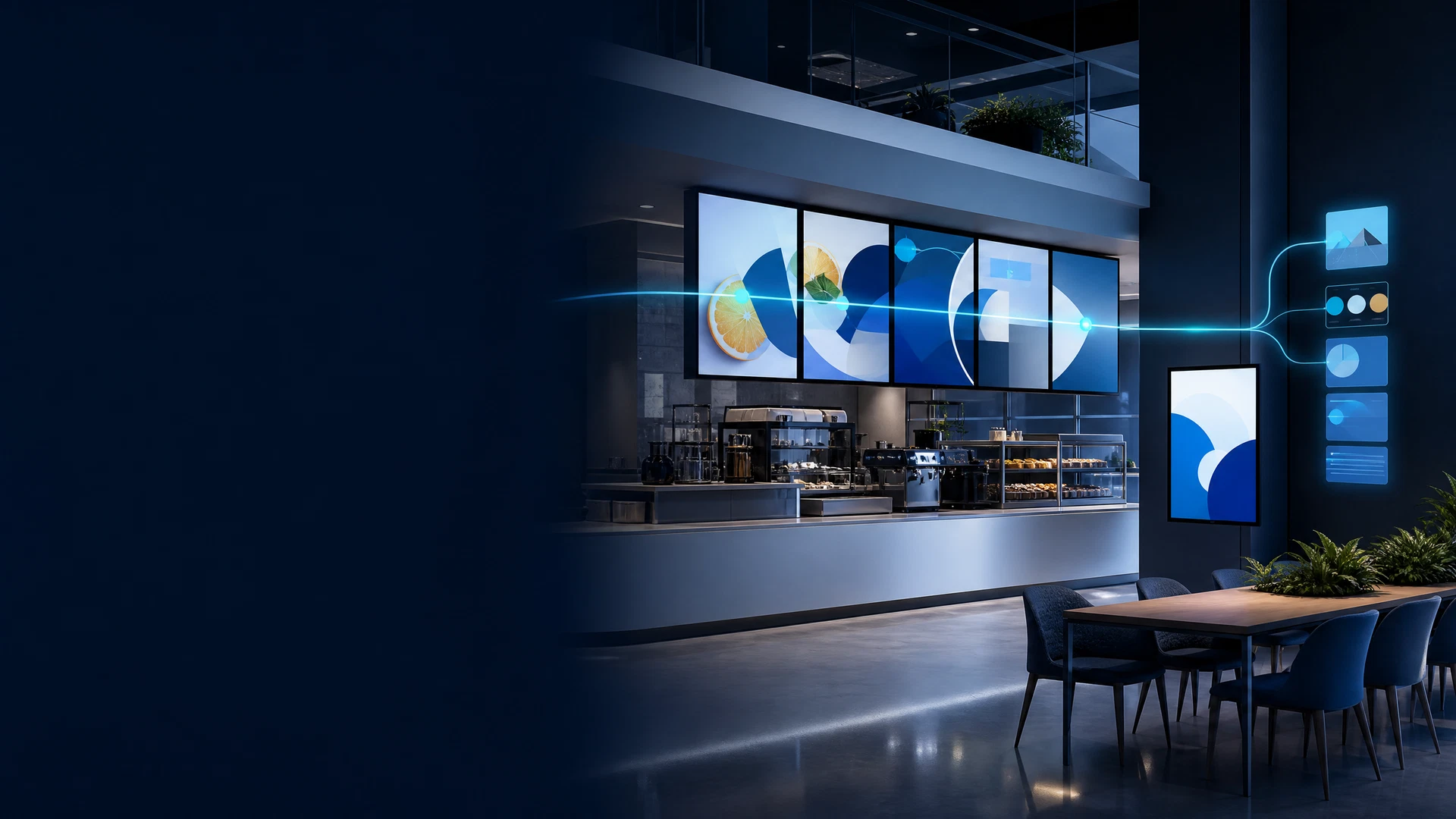
Illustrative media is retained only where it is clear, purposeful, and does not imply feature parity, customer deployment, or unverified integrations.
Compare the commercial model
Review the delivered scope, not an entry licence alone.
Commercial comparison should separate the core platform, included feature scope, hardware, installation, content work, third-party integration, device-management requirements and service arrangement. Dhruv’s commercial position is a fixed platform price for the agreed feature scope: where a feature is included in that agreed scope, it is not separately charged as an add-on. Hardware, specialist implementation work and provider-specific third-party services should still be assessed against the exact solution design.
Samsung’s public pricing information lists VXT plan series and states that individual marketplace applications can require separate purchase; it also notes that compatibility and feature availability vary by model and selected plan.[2] This is a useful reminder to compare the full delivery model, not only an entry licence.
A practical shortlist
Ask every provider the same questions.
Which exact displays, players, operating systems and device-management functions are in scope?
Which content and response workflows are native, configured or provider-specific?
What is included in the agreed platform fee, and what requires a separate application, integration or service?
Which EPOS, data and API flows are live today, and which require a scoped project?
How does the platform validate resolution, format and screen-group compatibility before publishing?
What is the controlled flow for priority or emergency communication?
The practical conclusion
There is no single correct CMS for every organisation. Samsung VXT, Zeetaminds and NowSignage each publicly present established CMS and operational-management propositions with different hardware, deployment and feature-model considerations. Dhruv’s point of difference is a vertically designed QSR and Workplace approach that joins content workflow, screen context, compatible publishing, controlled priority response and an agreed fixed-platform commercial model.
Discuss the screen estate in scopeThis comparison reflects publicly available provider material reviewed on 26 August 2026. Product capability, hardware compatibility, pricing, integrations and commercial terms change. It is a procurement framework, not a guarantee of feature equivalence; exact implementation scope should be confirmed directly with each provider.